
 Call us: +919355614666


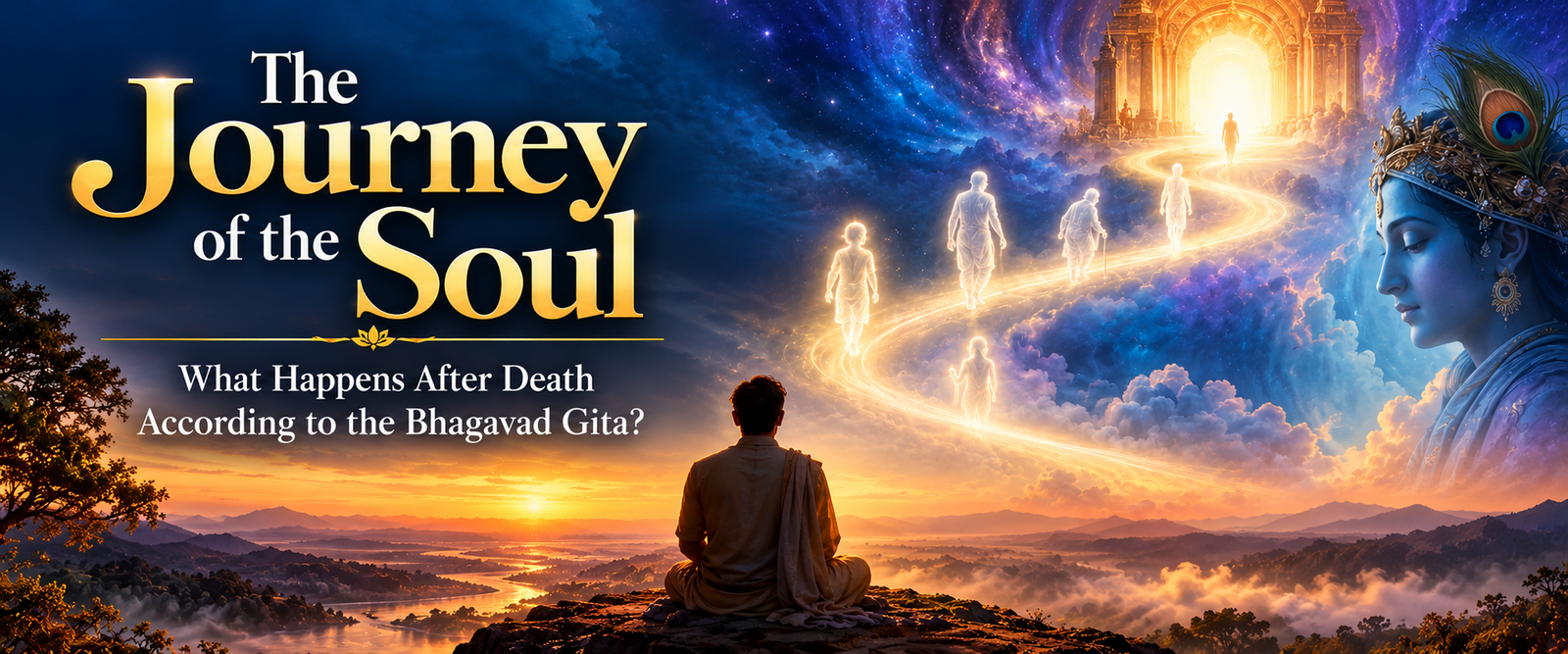


Have you ever lost someone so dear to your heart that their absence created a void nothing could ever fill? Have you ever looked at an old photograph, remembered their laughter, or wished you could hear their voice just one more time?
When someone we love dies, we often ask ourselves questions that have troubled humanity for thousands of years. Where have they gone? Does something of them continue to exist? Will we ever meet them again? Is death truly the end of everything?
We spend our lives building relationships, accumulating wealth, fulfilling ambitions, and creating memories. Yet one day, we must leave behind everything we identify as ours. The body that we nurture throughout our lives eventually returns to nature.
But what if death is not the end of our existence? What if it is merely the beginning of another journey?
The Bhagavad Gita offers profound spiritual insights into the eternal nature of the soul, the mysteries of death, reincarnation, karma, and liberation. Through his teachings to Arjuna, Lord Krishna reveals that while the physical body is temporary, the soul continues its journey beyond death.
The Bhagavad Gita teaches that our true identity is not the physical body but the eternal Atman, or soul.
In Chapter 2, Verse 20, Lord Krishna explains:
Bhagavad Gita 2.20
na j?yate mriyate v? kad?cin
n?ya? bh?tv? bhavit? v? na bh?ya? |
ajo nitya? ???vato 'ya? pur??o
na hanyate hanyam?ne ?ar?re ||
Translation: The soul is never born, nor does it ever die. It has not come into existence, does not come into existence, and will not come into existence. It is unborn, eternal, everlasting, and ancient. It is not destroyed when the body is destroyed.
This verse establishes a fundamental principle of Vedic philosophy: the soul is eternal, while the physical body is temporary.
Our bodies undergo constant transformation. We move from childhood to youth, from youth to old age. Yet, throughout these changes, our inner sense of existence continues.
According to the Bhagavad Gita, death marks the destruction of the physical body, not the annihilation of the soul.
Lord Krishna explains the soul's journey through a simple yet profound analogy.
Bhagavad Gita 2.22
v?s??si j?r??ni yath? vih?ya
nav?ni g?h??ti naro 'par??i |
tath? ?ar?r??i vih?ya j?r??ny
any?ni sa?y?ti nav?ni deh? ||
Translation: Just as a person discards worn-out garments and puts on new ones, the embodied soul gives up old and worn-out bodies and accepts new ones.
Imagine changing your clothes at the end of the day. The garments change, but the person wearing them remains the same.
Similarly, according to the Bhagavad Gita, the soul abandons a physical body that has completed its journey and enters another.
This process is known as Punarjanma, or reincarnation.
The soul's journey continues through different births, each shaped by karma, desires, and the influence of material nature.
Death, therefore, is not the destruction of existence but a transition from one physical form to another.
One of the most fascinating questions surrounding death concerns what happens when the soul leaves the physical body.
Does the soul carry anything from its previous existence? What determines its next destination?
Lord Krishna provides an important explanation in Chapter 15.
Bhagavad Gita 15.8
?ar?ra? yad av?pnoti
yac c?py utkr?mat??vara? |
g?h?tvait?ni sa?y?ti
v?yur gandh?n iv??ay?t ||
Translation: When the embodied living being acquires a new body or leaves an existing one, it carries the mind and senses along, just as the wind carries fragrances from their source.
The wind-and-fragrance analogy reveals the subtle nature of the soul's journey.
Although fragrance cannot always be seen, it can be carried from one place to another. Similarly, the embodied soul is described as carrying the subtle faculties of mind and senses when it leaves one physical body and enters another.
Our accumulated desires, tendencies, attachments, and impressions influence our continued existence.
Thus, the soul's journey after death is deeply connected to the life we have lived.
Why do individuals experience different circumstances in life? Why are some born into prosperity while others encounter difficulties?
Vedic philosophy explores these questions through the doctrine of Karma.
Karma means action, and our actions generate consequences. According to the teachings of the Bhagavad Gita, the embodied soul experiences material existence under the influence of nature, attachment, and the consequences of its actions.
The doctrine of karma does not simply describe punishment and reward. It concerns the relationship between our actions, intentions, desires, and their consequences.
Our present actions shape our future experiences, while unresolved attachments and desires keep the cycle of birth and death going.
The deeper lesson of karma is not to judge another person's suffering but to recognise our responsibility for the choices we make.
Perhaps one of the most intriguing teachings of the Bhagavad Gita concerns the state of consciousness at the moment of death.
Bhagavad Gita 8.6
ya? ya? v?pi smaran bh?va?
tyajaty ante kalevaram |
ta? tam evaiti kaunteya
sad? tad-bh?va-bh?vita? ||
Translation: Whatever state of being one remembers when leaving the body, O son of Kunti, that state one certainly attains, having been constantly absorbed in its contemplation.
This verse reveals the profound relationship between consciousness and the soul's destination after death.
But does this mean that a single thought at the moment of death determines our entire future?
The teaching is deeper than that.
Our final state of consciousness is shaped by the thoughts, desires, attachments, and habits we cultivate throughout our lives.
A person whose consciousness remains absorbed in material attachments continues to be influenced by those attachments. A spiritual practitioner who gradually cultivates devotion, detachment, and self-realisation directs consciousness towards the Divine.
The preparation for death does not begin when death approaches. It begins with the way we choose to live.
Every thought, action, and spiritual practice shapes our consciousness.
The Bhagavad Gita describes the recurring cycle of birth and death as Samsara.
Bhagavad Gita 2.27
j?tasya hi dhruvo m?tyur
dhruva? janma m?tasya ca |
tasm?d aparih?rye 'rthe
na tva? ?ocitum arhasi ||
Translation: For one who has taken birth, death is certain; and for one who has died, birth is certain. Therefore, one should not lament over what is inevitable.
Everything born into the material world must eventually perish.
The human body is subject to ageing, disease, and death. Yet, according to the Bhagavad Gita, the eternal soul continues its journey through successive births.
This cycle persists as long as the individual remains bound by ignorance, desires, attachment, and the influence of material nature.
However, the Bhagavad Gita also reveals that reincarnation is not the soul's ultimate destiny.
A state beyond the cycle of birth and death exists.
That state is called Moksha.
If the soul is eternal, why must it repeatedly experience birth, suffering, ageing, and death?
The spiritual traditions of India explain that ignorance of our true nature and attachment to material existence keep the individual soul bound to Samsara.
The ultimate purpose of spiritual practice is to transcend this bondage and attain liberation.
Bhagavad Gita 8.15
m?m upetya punar janma
du?kh?layam a???vatam |
n?pnuvanti mah?tm?na?
sa?siddhi? param?? gat?? ||
Translation: Having attained Me, the great souls who have achieved the highest perfection do not take birth again in this temporary world filled with suffering.
This verse reveals the ultimate spiritual destination Lord Krishna describes.
Through devotion, self-realisation, spiritual discipline, and knowledge of the Supreme, the individual can transcend the cycle of birth and death.
Moksha is not simply an escape from suffering. It is liberation from ignorance, material bondage, and the repeated experience of mortal existence.
Different schools of Indian philosophy explain liberation in different ways, including realising Brahman and attaining the Supreme Divine.
Yet, they share a central understanding: human life offers an extraordinary opportunity for spiritual awakening.
We spend much of our lives preparing for the future.
We prepare for education, careers, marriage, financial security, retirement, and countless other milestones.
But how often do we prepare for the one event that every living being must eventually encounter?
Death.
We know that our physical existence is temporary, yet we live as though everything around us will remain forever.
The Bhagavad Gita invites us to examine a deeper purpose of human existence.
Are we here merely to accumulate possessions, satisfy desires, and enjoy temporary pleasures? Or is human life an opportunity to understand our true nature and move towards spiritual liberation?
Spiritual growth does not require abandoning our families, responsibilities, or worldly duties. It requires performing those duties with awareness, compassion, discipline, and freedom from excessive attachment.
The journey towards liberation begins when we question our identification with the temporary body and seek to understand the eternal self.
Every act of kindness, every moment of self-reflection, every effort towards spiritual discipline, and every step towards self-realisation becomes part of that journey.
The Bhagavad Gita offers a perspective on death that transforms how we understand life itself.
It teaches that the soul is eternal, that the physical body is temporary, and that karma and consciousness influence the journey through birth and rebirth.
Most importantly, it reminds us that human existence carries a purpose beyond material achievements.
The ultimate goal is not merely to secure a better next life but to transcend the cycle of reincarnation altogether.
Perhaps the greatest tragedy of human existence is not that we must one day die, but that we may spend an entire lifetime without discovering who we truly are.
We spend our lives preparing for a better tomorrow, but how much time do we spend preparing for eternity?
The body has a destination called death. The soul has a destination called liberation.
And the true purpose of life is to discover the path that leads from one to the other.







Comments
Add comment
No comment available