
 Call us: +919355614666




Have you ever met someone and felt an instant connection, almost as though you had known them forever? Something about them feels strangely familiar. You feel comfortable in their presence, conversations flow effortlessly, and even though you have only just met, part of you feels like you are reconnecting with someone from your past.
And then some people enter your life and turn everything upside down. They challenge your beliefs, awaken your deepest insecurities, break your heart, or change the direction of your life entirely. Sometimes, even after they leave, their impact stays with you for years.
Why do certain people affect us so deeply? Why do we repeatedly find ourselves in similar relationships, facing the same emotional struggles, even when the people involved are completely different?
Is it all coincidence, or is there something deeper at work?
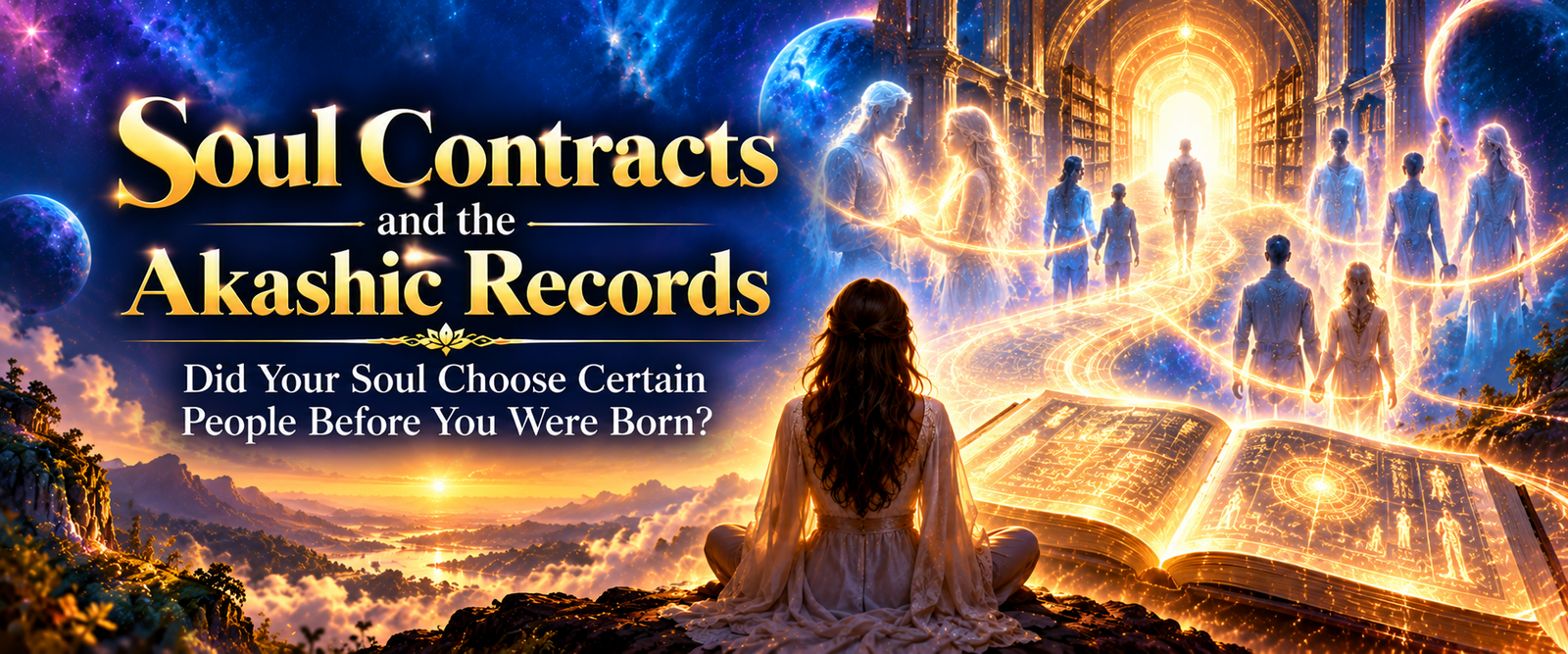
In the spiritual understanding of the Akashic Records, a fascinating concept is known as Soul Contracts. It suggests that some of the people we encounter and certain experiences we undergo may be connected to spiritual agreements made before our birth.
The idea is both intriguing and deeply personal because it invites us to look at our lives from an entirely different perspective.
Imagine, for a moment, that your existence did not begin on the day you were born. Imagine that, before entering this physical world, your soul existed in a state of consciousness where it could reflect on its previous experiences and consider what it wanted to learn next.
According to contemporary Akashic spirituality, a soul may enter a lifetime with certain intentions. It may seek to understand love, forgiveness, patience, courage, self-worth, or detachment. And to experience these qualities, it may form agreements with other souls who will play significant roles in its journey.
These spiritual agreements are commonly called Soul Contracts.
A soul contract is not imagined as a physical document signed somewhere in the heavens. Rather, it represents an understanding or intention between souls to participate in experiences that encourage their spiritual development.
For example, someone may enter your life and teach you the meaning of unconditional love. Another person may challenge you so deeply that you finally recognise your own worth. A painful relationship ending may become the turning point that encourages you to rediscover yourself.
In this belief system, the significance of a relationship is not measured by how long it lasts but by what it awakens within us.
However, soul contracts are spiritual interpretations, not scientific facts. They offer one possible way of contemplating the meaning of our experiences, not proof that every event was planned before birth.
To understand soul contracts, we must first explore their connection with the Akashic Records.
The word Akasha originates from Sanskrit and is traditionally associated with space or ether. In modern esoteric spirituality, the Akashic Records are described as a vast, non-physical repository of information containing the impressions of consciousness and the experiences of souls.
Imagine a library unlike anything we have ever seen. There are no ordinary books, shelves, or written documents. Instead, every soul is believed to have an energetic record containing its experiences, relationships, choices, karmic patterns, and spiritual possibilities.
Within this understanding, soul contracts are believed to form part of the information associated with an individual's Akashic Records.
An Akashic reading may therefore explore why a particular relationship feels unusually significant, why certain patterns continue to repeat, or what spiritual lessons a person associates with an experience.
For instance, someone who repeatedly finds themselves in relationships where they feel neglected may begin to wonder whether there is a deeper pattern they need to understand.
An Akashic interpretation might describe this as a lesson concerning self-worth or emotional independence.
Yet the real value of such an exploration lies in what the individual learns about themselves. Whether or not one accepts the metaphysical explanation, recognising unhealthy patterns can create opportunities for meaningful change.
Think about the people who have influenced your life.
Some have loved you unconditionally. Some have supported you when you had almost given up. Others have disappointed you, betrayed your trust, or left you questioning everything you once believed.
Interestingly, the people who teach us the most are not always the people who make us happiest.
In soul-contract spirituality, some relationships are believed to connect to lessons the soul wants to explore.
A loving parent may help a child understand security and compassion. A close friendship may teach loyalty and trust. A challenging relationship may reveal patterns of emotional dependence or the importance of personal boundaries.
Sometimes, a person remains in our life for decades. Sometimes, an encounter lasting only a few weeks changes our outlook forever.
The soul-contract perspective suggests that the importance of these connections may lie in the transformation they inspire.
But this idea requires an important distinction.
Not every painful relationship is a spiritual lesson we must endure.
No one should be told that they chose abuse, betrayal, or suffering before birth. Spirituality should never become a justification for mistreatment or an excuse to remain in a harmful situation.
Sometimes, the most important realisation is that we deserve better and can walk away.
Most of us associate the word soulmate with romantic love. We imagine that somewhere in the world, one person is destined to complete us.
But contemporary Akashic teachings often present a much broader understanding.
A soulmate may be a friend who understands you without explanation, a sibling with whom you share an extraordinary bond, or a teacher whose words transform your life.
The connection need not be romantic, and it does not necessarily have to last forever.
Then there are relationships commonly described as karmic connections.
Have you ever noticed that despite changing partners, friendships, or circumstances, you somehow encounter the same emotional problem?
Perhaps you repeatedly feel unappreciated. Perhaps you struggle to trust others. Perhaps you constantly try to rescue people at the expense of your own happiness.
Within the Akashic framework, such patterns may be interpreted as unresolved karmic lessons.
Some practitioners believe that souls can encounter one another across multiple lifetimes, sometimes assuming different roles in different incarnations.
A person who was a friend in one lifetime might be imagined as a family member in another. Someone with whom we shared an unresolved conflict might reappear in a different relationship.
These ideas are not verifiable accounts of past lives, but they offer a symbolic way of reflecting on the relationships that shape us.
And perhaps that is where their deeper value lies.
Instead of endlessly asking, "Why does this keep happening to me?" we may begin asking, "What pattern am I repeating, and what can I do differently?"
That single change in perspective can be transformative.
The concepts of karma and reincarnation have been explored in Indian philosophy for thousands of years.
The Bhagavad Gita explains that the embodied soul continues beyond the physical body's destruction.
In Chapter 2, Verse 22, Lord Krishna states:
v?s??si j?r??ni yath? vih?ya
nav?ni g?h??ti naro 'par??i |
tath? ?ar?r??i vih?ya j?r??ny
any?ni sa?y?ti nav?ni deh? ||
Translation: Just as a person discards worn-out garments and puts on new ones, the embodied soul abandons old bodies and enters new ones.
This verse establishes reincarnation within the Bhagavad Gita's philosophical framework.
Karma, meanwhile, concerns actions and their consequences. Our intentions, choices, and behaviour influence the experiences that shape our existence.
Modern Akashic spirituality sometimes brings these ideas together with the concept of soul contracts, suggesting that certain relationships may provide opportunities to recognise and transform karmic patterns.
However, the Bhagavad Gita does not explicitly teach that souls negotiate contracts with one another before birth. The soul-contract framework is a later metaphysical interpretation, and the two teachings should not be confused.
Their philosophical connection lies in the possibility that our present experiences can become opportunities for greater awareness and spiritual development.
This is where the concept of soul contracts becomes particularly interesting.
If souls supposedly agree to certain experiences before birth, does that mean everything in our lives is already decided?
Are we simply actors following a script written before we arrived?
Not necessarily.
Many contemporary soul-contract teachings suggest that a spiritual intention does not eliminate free will.
Imagine that you decide to travel to a particular destination. You may know where you wish to go, but the route you take, the decisions you make, and the experiences you encounter along the way can still vary.
Soul contracts are sometimes understood similarly.
A soul may be believed to have an intention to develop courage, but the circumstances through which courage is expressed are not necessarily fixed.
A person may wish to learn forgiveness, but forgiveness remains a choice rather than an obligation.
This distinction is essential because it preserves individual responsibility.
Our past, whether understood psychologically or spiritually, may influence us, but it does not have to control every decision we make.
Spiritual awareness should expand our freedom, not convince us our future is already decided.
Have you ever remained emotionally attached to someone long after a relationship ended?
Perhaps you know the relationship was unhealthy, yet something within you still holds on. You replay old conversations, question what went wrong, or wonder why you cannot simply move forward.
Within Akashic healing traditions, these experiences are sometimes interpreted as unresolved soul contracts.
Practitioners may speak about releasing, clearing, or completing such agreements.
But what does releasing a soul contract actually mean?
From a spiritual perspective, it may symbolise the decision to stop repeating a destructive pattern.
Someone who has always sacrificed their happiness for others may finally learn to establish boundaries. Someone who constantly seeks approval may begin developing self-confidence. Someone who carries resentment may gradually find the strength to let go.
These transformations do not require us to prove that a spiritual agreement existed.
What matters is recognising the patterns influencing our lives and consciously choosing how we want to move forward.
A meditation or Akashic visualisation may help someone reflect upon these experiences, but it should not be presented as a guaranteed method of erasing trauma or changing another person's behaviour.
Sometimes, completing a perceived soul contract means accepting that a chapter of our life has ended.
And that acceptance can be profoundly liberating.
In contemporary Akashic practices, individuals sometimes seek readings to explore their relationships, recurring challenges, and perceived spiritual purpose.
A practitioner may use prayer, meditation, or intuitive visualisation to contemplate these questions.
For example, imagine someone who has repeatedly experienced relationships in which they feel responsible for fixing everyone else's problems.
During an Akashic exploration, they may reflect upon why they associate love with sacrifice.
Perhaps they discover that they have always believed their value depends on how much they do for others.
They may then recognise that compassion does not require abandoning their own needs.
An Akashic practitioner might interpret this realisation as an understanding of a soul contract about self-worth.
Whether the experience is understood spiritually or psychologically, the resulting awareness may be valuable.
The important thing is to approach such readings with discernment.
An ethical practitioner should not claim unquestionable knowledge of another person's past lives, declare that suffering was predetermined, or insist that a client must remain connected to someone because of an alleged karmic agreement.
Akashic exploration is most constructive when it encourages reflection, personal responsibility, and freedom of choice.
We often focus so much on why other people entered our lives that we forget to examine our relationship with ourselves.
We search for answers about soulmates, past-life connections, karmic partners, and unfinished spiritual agreements.
But perhaps an equally important question is whether we are living in alignment with our own values.
Are we constantly compromising our happiness to please others? Are we holding on to relationships that no longer support our growth? Are we repeating familiar patterns simply because change feels uncomfortable?
The soul-contract framework invites us to consider that our experiences may hold deeper meaning.
Yet meaning does not always have to come from something decided before birth.
Sometimes, we create meaning through the choices we make today.
We cannot change every event that has occurred in our lives. We cannot control how others behave, and we cannot always understand why certain relationships unfold the way they do.
But we can choose how we respond.
We can learn to forgive without returning to harmful situations. We can love without losing ourselves. We can recognise our mistakes without letting guilt define our identity.
And perhaps these choices are more spiritually significant than discovering the details of any supposed agreement from a previous lifetime.
One of the most beautiful aspects of the soul-contract concept is the possibility that relationships are not merely about possession or permanence.
Some people may enter our lives to walk beside us. Others may accompany us only for a short distance.
Some relationships inspire love and joy, while others force us to confront aspects of ourselves we might otherwise ignore.
But not every connection is meant to last forever.
Sometimes, growth requires holding on. At other times, it requires letting go.
The deeper spiritual question is not whether every person we encounter was destined to meet us.
It is whether we are becoming more conscious, compassionate, and responsible through the experiences we share.
In Indian spiritual philosophy, the ultimate goal of the soul is not endless participation in worldly experiences but liberation from ignorance, attachment, and the cycle of birth and death.
When viewed from this perspective, the highest purpose of spiritual learning is freedom.
Freedom from fear. Freedom from unhealthy attachment. Freedom from patterns that prevent us from recognising our true nature.
And perhaps freedom from the need to explain every relationship as destiny.
Perhaps, before we entered this world, there were intentions we cannot remember and connections we do not fully understand.
Perhaps some of the people who crossed our paths have influenced us in ways that feel too profound to dismiss as coincidence.
Or perhaps the meaning of these encounters lies not in an agreement made before birth but in what they awaken within us today.
The Akashic understanding of soul contracts offers a fascinating spiritual lens through which to contemplate these possibilities.
It reminds us that relationships can become mirrors, reflecting our deepest fears, greatest strengths, unresolved emotions, and capacity for transformation.
But we must remember that spirituality should never take away our freedom to choose.
We are not obligated to remain trapped in painful circumstances because someone calls them karmic. We are not required to preserve every relationship simply because it feels spiritually significant.
Sometimes, the greatest lesson is learning to love. Sometimes, it is learning to forgive. And sometimes, it is learning to leave.
Perhaps the real mystery is not whether we chose the people who would enter our lives before we were born, but whether we recognise what their presence teaches us while we are here.
Because ultimately, the journey of the soul is not only about the experiences we encounter.
It is about the consciousness we develop through them, the freedom we discover within ourselves, and the person we choose to become.








Comments
Add comment
No comment available